


What Is Remote Robotic Surgery? Lessons From the US and Türkiye
A robotic prostatectomy in the US and a robotic hysterectomy linking Istanbul and Muş put telesurgery in the spotlight. Clinical evidence, expertise sharing and patient safety.
Short answer: Remote robotic surgery allows a surgeon to control robotic surgical instruments through a communications link without being in the same operating room as the patient. A robotic prostate operation reported in the US and a robotic hysterectomy linking Istanbul and Muş in October 2026 are recent examples of its use across different centres. These developments do not establish that telesurgery is standard care for every patient or that it produces better outcomes than existing surgery. [1, 2]
Although distance attracts attention, the central clinical question is not how many kilometres separate the surgeon and patient. Whether sharing expertise benefits the patient, whether the connection is reliable and whether the bedside team can intervene must be assessed together.
How does remote robotic surgery work?
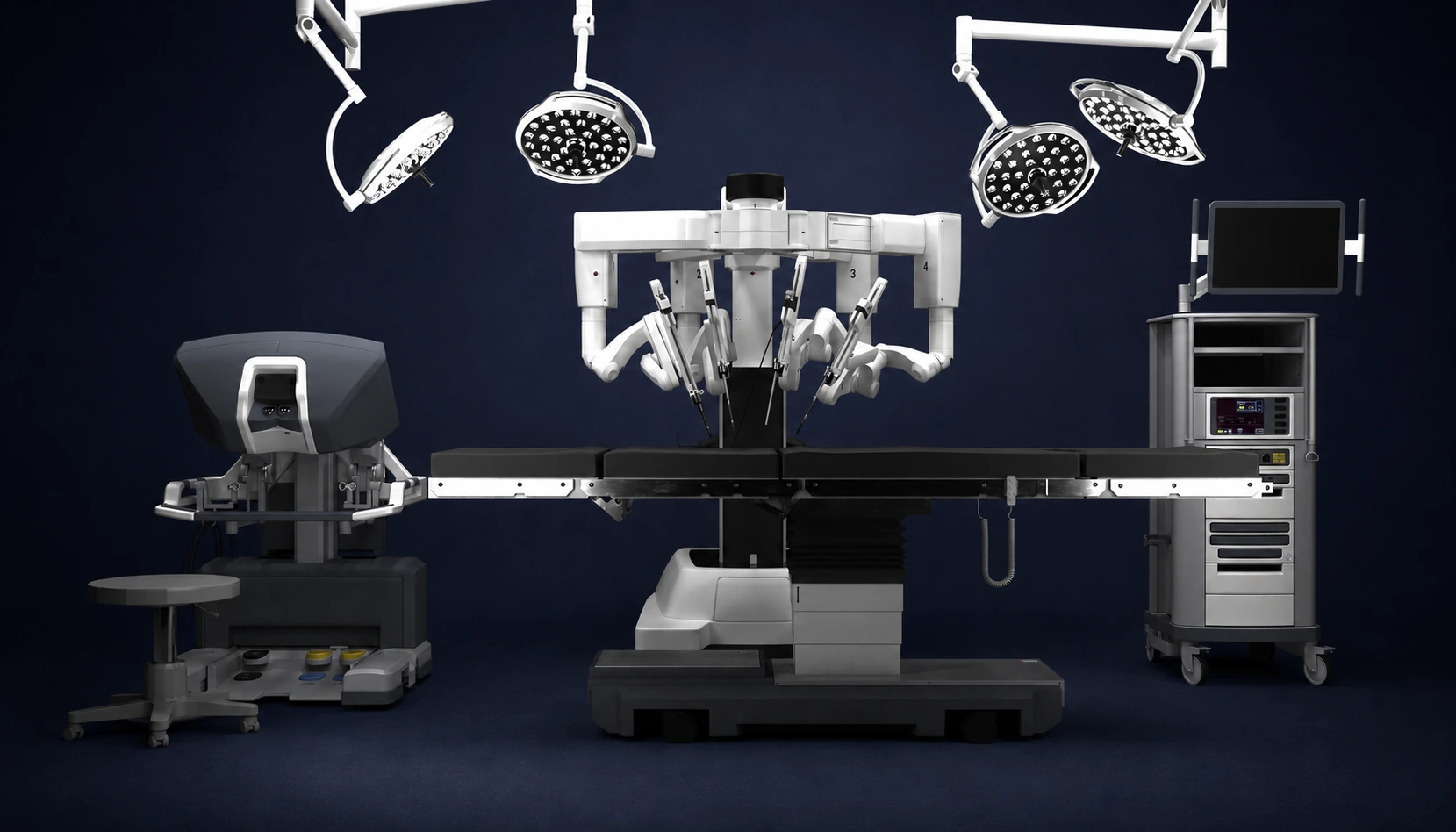
In robotic surgery, the surgeon uses console controls to operate instruments positioned beside the patient. In telesurgery, the console and patient-side system may be at different centres, with images and control data transmitted through communications infrastructure.
Safety therefore depends on more than the robot. Network performance, backup communications, coordination between teams and an on-site contingency plan are also part of the system. The American College of Surgeons highlights training, informed consent and failure scenarios alongside technical feasibility. [6]
Are telesurgery and telementoring the same?
In telesurgery, the remote surgeon directly controls instruments to perform part or all of an operation. In telementoring, the remote specialist provides advice and educational support to the surgeon beside the patient.
Both approaches can be used during the same operation. In the Muş case, the surgeon’s own account describes both remote intervention and guidance. It would therefore be inaccurate to describe the entire procedure as an operation performed remotely by one surgeon alone. [2]
What happened during the remote prostate operation in the US?
According to AdventHealth’s statement dated October 26, 2026, a 66-year-old patient with prostate cancer underwent an investigational robotic prostatectomy on October 25.
Dr Vipul Patel operated from a console at AdventHealth Celebration, while the patient was approximately 35 miles, or 56 kilometres, away at AdventHealth Minneola. Dr Marcio Moschovas and the surgical team were at the bedside to support the procedure and intervene if needed. The investigational Toumai system was used. AdventHealth describes the procedure as one case within an ongoing investigation. [1]
What does FDA authorization for research mean?
The procedure took place under an Investigational Device Exemption, or IDE. An IDE permits an investigational device to be used in a clinical study to collect safety and effectiveness data.
This does not mean that the device has received routine marketing authorization for the use being investigated or that its safety and effectiveness have been established. “A system used in a clinical investigation under an FDA-approved IDE” is therefore more accurate than “an FDA-approved remote surgery system.” [5]
How was robotic surgery performed between Istanbul and Muş?
Reports published on October 23, 2026 described a robotic hysterectomy conducted through a connection spanning approximately 1,400 kilometres between the TÜSEB İDEA centre in Istanbul and Muş State Hospital.
Assoc. Prof. Dr Derman Başaran of Hacettepe University connected to the system from Istanbul, while Dr Haticegül Tuncer held the bedside surgical responsibility in Muş. DHA also reported completion of the procedure between the two centres. [3]
According to Başaran’s account to Anadolu Agency, the patient did not have a cancer diagnosis; the operation addressed ongoing heavy bleeding. The Muş case therefore illustrates remote surgical collaboration. It is not evidence of treatment success in gynaecological cancer. [2]
What do the two reports have in common, and how do they differ?
| Aspect | US example | Istanbul–Muş example |
|---|---|---|
| Reported procedure | Robotic prostatectomy for prostate cancer | Robotic hysterectomy for bleeding |
| Connection | Celebration–Minneola | TÜSEB İDEA–Muş State Hospital |
| Reported distance | Approximately 56 km | Approximately 1,400 km |
| Bedside support | Surgeon and surgical team | Local surgeon and surgical team |
| What the report shows | Remote surgery within a clinical investigation | Collaboration across centres through remote surgery and mentoring |
These two cases are not comparison groups in a clinical trial. A longer distance does not establish higher surgical quality or greater patient benefit.
Is the scientific evidence limited to individual operations?
No. A multicentre randomized trial published in The BMJ on January 28, 2026 assigned 72 patients scheduled for radical prostatectomy or partial nephrectomy to telesurgery or local robotic surgery. Following withdrawals, 32 patients underwent telesurgery and 31 underwent local surgery.
The study reported that telesurgery was non-inferior to local surgery for its prespecified surgical-success measure within the accepted non-inferiority margin. This does not demonstrate superiority or equivalence across all outcomes. Early recovery and complication assessments were based on follow-up at four and six weeks. The robotic platform also differed from those in these news reports. The results cannot automatically be generalized to every device and centre. [4]
Which outcomes matter for patients with prostate cancer?
Completing an operation remotely is an important technical outcome. Assessment of prostate cancer surgery extends further:
- Surgical margins, PSA follow-up and long-term cancer control.
- Recovery of urinary continence.
- Erectile function and quality of life.
- Complications and the need for additional procedures.
Early technical success alone does not establish better long-term outcomes. The value of new approaches requires adequate follow-up and appropriate comparisons.
What happens if the connection fails?
A contingency plan must be prepared before remote surgery begins. The assessment concerns more than internet speed: data latency, connection continuity, equipment failures and the bedside team’s ability to take over must all be considered.
Depending on the platform and hospital resources, plans may include local control or transition to another surgical approach. Remote expertise therefore does not replace the surgical and anaesthetic team at the patient’s hospital. [6]
What could patients gain?
The potential benefit is access to specialist surgical experience from another centre. Under suitable conditions, this may reduce travel burdens and enable local teams to work alongside experienced surgeons.
How far these possibilities translate into better healthcare must still be studied. Robotic infrastructure, trained staff, maintenance and resilient communications remain necessary. These two reports do not establish lower costs or a solution to inequalities in access to specialist care.
Editorial assessment
The shared value of the applications in the US and Türkiye is that they demonstrate the possibility of sharing surgical expertise across geographical boundaries. Collaboration between the local and remote surgeons in Türkiye is also noteworthy for training and knowledge transfer.
For urology, the decisive goal is to improve access to expertise while preserving cancer control, functional outcomes and patient safety, rather than to operate across the greatest distance. The future role of remote robotic surgery will depend on reproducible clinical outcomes alongside technical demonstrations.
Frequently asked questions
Does the robot perform the operation by itself?
In the procedures described here, surgeons control the instruments. Remote robotic surgery is different from autonomous surgery.
Was the Muş procedure an operation for prostate cancer?
No. The reported procedure was a hysterectomy, meaning removal of the uterus, because of bleeding.
Is remote surgery more successful?
These reports do not demonstrate superiority. The randomized trial assessed non-inferiority for a specific success measure; it did not establish better long-term outcomes.
Does a surgeon no longer need to be beside the patient?
No. Both cases had bedside surgical support. The local team’s responsibility is a fundamental part of a telesurgery arrangement.
Sources
- Historic study explores whether robotic telesurgery could bring specialized surgical care closer to home. October 26, 2026 [Internet]. Available from: https://www.adventhealth.com/news/historic-study-explores-whether-robotic-telesurgery-could-bring-specialized-surgical-care-closer
- Meral RM. Robotic surgery for a patient 1,400 kilometres from TÜSEB İDEA. October 23, 2026 [Internet]. Available from: https://m.aa.com.tr/tr/gundem/tuseb-ideadan-1400-kilometre-uzaktaki-hastaya-robotik-cerrahi/4098646
- Maral MS. Surgery using telesurgery across 1,400 kilometres. October 23, 2026 [Internet]. Available from: https://www.dha.com.tr/gundem/1400-kilometre-uzaktan-telecerrahi-yontemiyle-ameliyat-2968566
- Reliability of urological telesurgery compared with local surgery: multicentre randomised controlled trial. BMJ. 2026;392:e083588. doi:10.1136/bmj-2024-083588 · PubMed · PMC
- FAQs about Investigational Device Exemption. Accessed October 28, 2026 [Internet]. Available from: https://www.fda.gov/medical-devices/investigational-device-exemption-ide/faqs-about-investigational-device-exemption
- Telesurgery Is Moving from Possibility to Practice [Internet]. 2026. Available from: https://www.facs.org/for-medical-professionals/conferences-and-meetings/clinical-congress-2026/cc2026-news/telesurgery-is-moving-from-possibility-to-practice/
Keep reading:
Related news
Combined Robotic Prostate and Adrenal Surgery: Why Planning Matters
An account of combined robotic prostate and adrenal surgery, surgical planning, teamwork and Dr Şahin Kılıç's role in the adrenal procedure.
Is Renorrhaphy Really Necessary in Robotic Partial Nephrectomy?
A randomised trial of 248 patients found that, for selected kidney tumours, omitting renorrhaphy met its non-inferiority criterion for surgical success. A urinary-fistula signal and short follow-up limit generalisation.
Can Kidney Transplantation Be Robotic? Results of the First Randomised Trial
In ORAKTx, 106 patients completed transplantation. Thirty-day complications were numerically fewer with robotic surgery, but the trial did not prove superiority over open surgery.